
The problem with traditional change ROI
(and what to do instead)

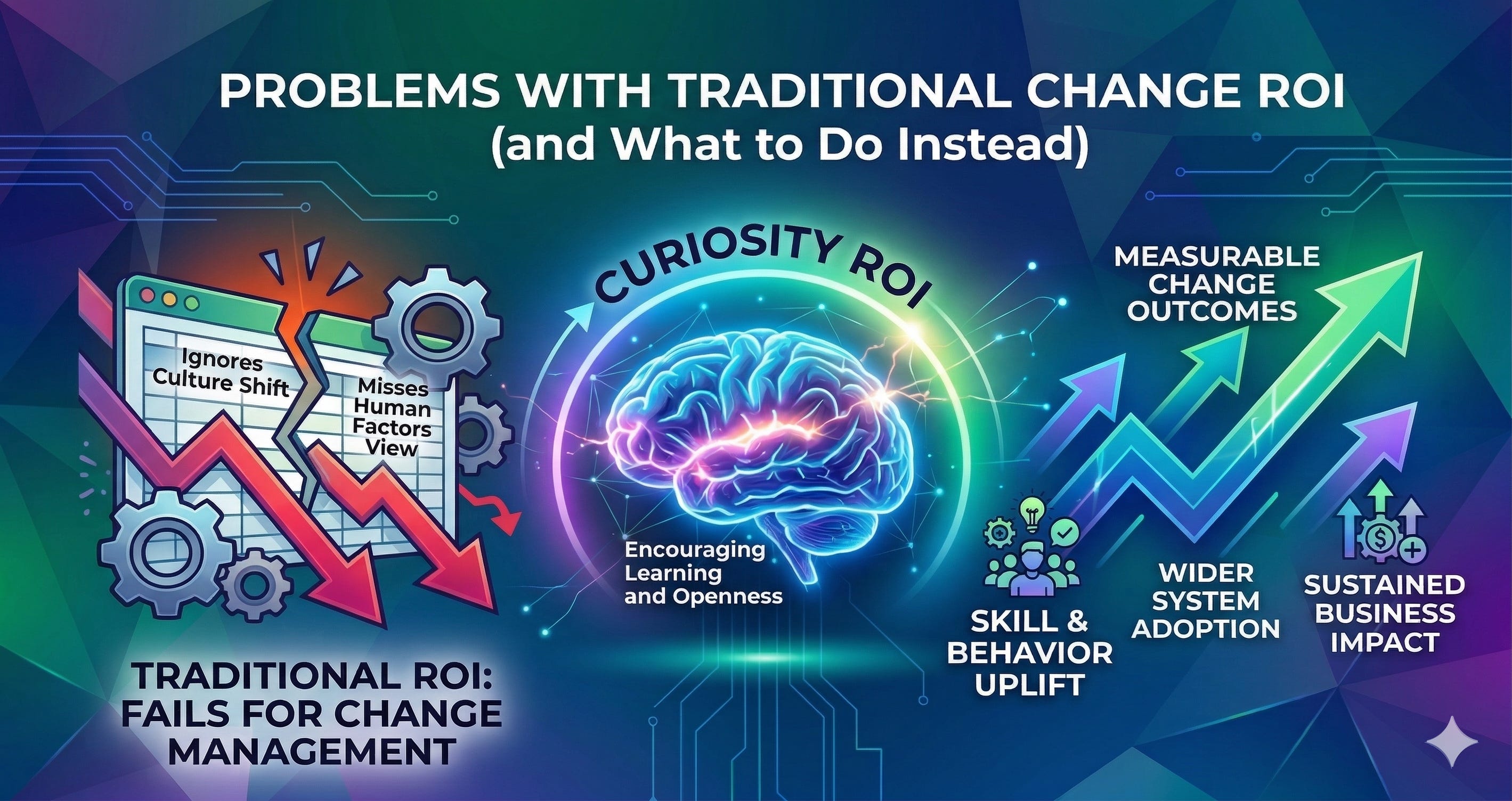
Every change manager I know has had this conversation.
You spend months building a rollout plan, designing training, managing resistance and guiding an organization through a genuinely difficult shift. The change happens. Adoption improves. Something measurably better is now true about how people work.
And then someone in a leadership meeting asks: “But what’s the ROI?”
The honest answer is that traditional ROI frameworks were not built for change. They were built for capital investments, where you know the inputs and can measure the outputs in dollars. Change does not work that way. And yet we keep trying to force it into that box.
Why traditional ROI fails for change
Traditional return on investment asks a simple question: what did you put in and what did you get back? For a piece of equipment, that is reasonable. You know the cost. You can measure the throughput. You calculate the return.
For a human behavior change, the inputs and outputs are far more complex. Traditional ROI frameworks for change tend to fail in three specific ways:
• They measure the wrong things. Training completion rates, communication open rates, session attendance. These are activity metrics, not outcome metrics. Activity does not tell you whether the change is working.
• They ignore the most important variables. Employee confidence, trust in leadership, psychological safety and culture shift do not fit neatly into a spreadsheet. So they get left out entirely. And leaders wonder why the ROI never quite captures what actually changed.
• They operate on the wrong timeframe. Behavior change takes time. A quarterly snapshot of a 12-month change initiative will almost always understate the value - because you are measuring before the value has had time to materialize.
Curiosity as a change accelerator - and how to measure it
Here is the reframe that changes everything: what if the missing variable in your ROI calculation is curiosity?
Not curiosity as a personality trait. Curiosity as an organizational behavior - something you can observe, build and measure.
The Curiosity ROI Playbook: The LEAPS Model was built on this idea. LEAPS connects five curiosity-driven behaviors to the measurable outcomes that actually move your change metrics. The five dimensions are:
• L - Learning Agility: The ability to adapt thinking and behavior based on feedback or new data. Observable in reflection sessions, coaching uptake and the speed with which teams update their approach. Links to faster adoption and stronger resilience.
• E - Experimentation: Testing ideas and adjusting based on what you learn rather than certainty. Observable in pilots, iterations and learning reviews. Links to reduced implementation risk and higher adoption rates.
• A - Ask Better Questions: The willingness to challenge assumptions and surface insight through inquiry. Observable in meeting dynamics, retrospectives and discovery conversations. Links to improved clarity and faster issue resolution.
• P - Psychological Safety: The shared belief that it is safe to speak up, question or fail forward. Observable in upward feedback, candid retrospectives and cross-level idea sharing. Links to greater trust and fewer hidden risks.
• S - Sensemaking: The ability to interpret complex change through inquiry and dialogue. Observable in group synthesis sessions, lessons-learned capture and how teams make meaning from ambiguous data. Links to alignment and reduced confusion.
The LEAPS Model is available within The Curiosity ROI Playbook for $149 USD.
These are not soft skills. They are observable behaviors that drive the hard outcomes - adoption, engagement, trust, clarity and innovation - that your leadership team actually cares about.
The curiosity ROI equation
The Curiosity ROI framework uses this equation:
Curiosity ROI = (Δ Adoption + Δ Trust + Δ Engagement + Δ Clarity + Δ Innovation Output) ÷ Investment in Curiosity Practices
This is not abstract. Using the example from the playbook, a 12-week intervention - Curiosity Corners in retrospectives, two micro-pilots and light leader coaching - cost approximately $15,000. The result was a 20-point adoption gain, a 15-point trust increase, an 8-point engagement lift, a 16-point clarity improvement and a 200% increase in implemented innovation ideas.
That is the ROI story your spreadsheet was never going to tell.
How to start
You do not need to overhaul your measurement approach. Start with one dimension this quarter.
• If adoption is your challenge: focus on Learning Agility and Experimentation first.
• If trust is your challenge: start with Psychological Safety and Ask Better Questions.
• If clarity is your challenge: begin with Sensemaking.
Pick one active change initiative. Identify simple data points you already have or can easily collect. Measure before and after. Then you have a story.
The LEAPS Model is available within The Curiosity ROI Playbook for $149 USD.
Stay Curious! 💡
P.S. What’s the hardest part of proving the value of your change work? Hit reply - I want to know.